Showing posts with label Writing. Show all posts

Wednesday, October 17, 2012

Savoring the Season

by Carissa Gan

The sky cracked one evening,
spilling warm hues over the earth.
The leaves drank the colors,
and leftovers dripped to the ground,
littering the grass with reds, oranges and yellows.
The sky cracked one evening,
pouring its sunset over the mountain crests.
The clouds whispered to each other,
their breaths as light and cool as the sunset breeze,
carrying the secrets of the sky through the valleys.
The sky cracked one evening,
bathing the garden in a glorious glow.
Bursts of golden rays filtered through the leaves,
as the kids carved pumpkins near the white wooden fence
while their mother sipped warm apple tea on the patio.
She gazed at the beauty of the evening,
at the oak tree shedding its leaves,
at the looming mountains in the distance,
and her senses were calmed
by the gentle breeze whistling through her hair,
by the smell of apples and fresh tea,
by the warmth of her cotton cardigan
by the toasty shades of the season
and by the sweet taste of autumn on her lips.

Writer's Block

As a journalism and creative writing student, one of the worst things that can happen is writer's block - the ominous mental block that suddenly curbs the flow of ideas from spilling onto the fresh page. It leaves me stumped and frustrated.

Someone said way to get over a writer's block is to just keep writing.

"Doesn't matter if your ideas aren't coming to you now, they eventually will as long as you just keep writing what's on your mind."

It's like turning on a rusty tap. The yellow, murky water trickles out first before a fresh stream of clean water can begin surging out.

I think that's a great idea. It's worked several times, but half the time my brain's just too exhausted to produce anything worthy of reading.

If you have figured a way to overcome writer's block, please feel free to leave comments below. :) Thank you!


Monday, September 03, 2012

Galveston Beach, Houston


I love the beach.
I love how the waves crash rhythmically upon the water and curl toward the shore.
I love standing right at the edge of the water and gazing out into the sea, at the massive horizon that stretches far ahead.
I love how the water twinkles under the glare of the morning sunlight.


I love curling my feet into the velvety brown sand and feeling its warmth as it wraps around my toes.
I love taking long, cool dips in the water before basking in the sun in hopes of a nice summer tan.


I love the sound of the birds singing freely in the skies, the rush of water and the gentle whistle of the wind as it caresses my face.
I love the salty smell of seawater riding on the back of the wind.


And I love the tranquility of relaxing by the beach, unperturbed by the usual roar of city life, and just allowing my thoughts to escape into serenity.


Written on the beach in my little travel journal under the blue skies of Galveston.


Friday, May 25, 2012

Beautiful Disaster


Angie pours herself another glass of champagne and watches the little bubbles fizz and pop. She catches sight of her reflection on the curve of the glass, which reflects a woman laden with misery. Her blue eyes are void of life. They carry the depth of pain unknown to many around her. Her blond hair is frizzy and she's still wearing the same green velvet robe from this morning. This is going to be a long, solemn evening.

The glass touches her lips and she drowns herself in the comfort of her drink. She drowns her misery in the bitterness of the champagne. The satisfaction lasts for a couple of minutes, and then she’s back for more, tipping the bottle a little higher than before to get the last of the champagne into her empty glass.

The lamp hanging above her head suddenly blinks, reeling her consciousness back to reality. Brian isn’t around to change the light bulbs anymore. In fact, he won’t be around for a long time, possibly forever. Her eyes dart to the picture of the two of them sitting on the mantelpiece, bordered by the crafty wooden frame she’d insisted they buy when they were in Italy last summer.

They looked so happy in the picture. It had been a windy fall afternoon two years back when their oldest son Maddox took that photo. Brian was wearing an old navy sweater and Angie was in a cream turtleneck and a turquoise cardigan. They had their arms around each other as they posed brightly for the camera on the creaky old swing in their backyard, like a happily married old couple. The two large oak trees in the background were solid and rooted to the ground, but the same could not be said about their marriage. 

Yes, even as Angie’s blue eyes were shining and Brian’s gray ones were crinkled at the sides as he grinned, Angie knew their happiness was false. The joy depicted in the picture was a deception to conceal all the bitter verbal lashings and angry tears throughout their twenty years of marriage. Deception was a game they played well. If the prize was separation, then they've both won.  

Angie thinks of all the guests who visited over the last two years, and how they stood at the mantelpiece admiring all the lovely family portraits of her family, including that picture of her and Brian.

“This is a great picture!” they’d say.

“Oh, yes, Maddox is an amazing photographer,” Angie would reply.

“Yes, he is. But I’m talking about you and Brian. You both look so good! So healthy, so happy.”

Of course they didn't know the truth hidden behind the smiles. They assumed everything they saw was real, from the gorgeous lilies in the living room to the cheerful family photos. They don't have to know the truth. Maybe someday they would, but not now.

The wounds are still so fresh. Angie isn’t ready to let anyone know Brian left her last night. She hasn’t called her family or her best friends. And she certainly isn’t going to tell her children. Not with Maddox studying for his finals in his dorm room and her daughter Elisha visiting her boyfriend in Spain.

It is just a matter of time before the children find out. Maddox’s graduation is in less than 3 weeks. Elisha will be flying back to attend her brother’s graduation. And Brian will be on the first plane out of Atlanta that morning. Everyone will be meeting up several hours before Maddox’s graduation ceremony to have lunch.

She and Brian are going to have to put on fake smiles again and pretend Brian hadn’t gone to Atlanta. The kids are not supposed to know he’d gone to live with his girlfriend. Laura is only a couple years older than Maddox, they could practically be siblings.

Brian had made Angie promise she wouldn’t say a word about his new relationship and about their plans for a divorce, at least not until Maddox’s graduation was over.

It pained Angie to reach that agreement. Accepting that Brian was in love with a younger woman was hard, but not as hard as learning he’d fallen out of love with herself. She saw it in his eyes many years ago, when Maddox and Elisha were still in high school. Brian stopped kissing her. He stopped touching her. He stopped planning their anniversaries. He simply stopped loving her, and there was nothing she could do about it. Whatever vows he'd made at the altar, he'd broken them. 

Angie didn’t know what triggered his change of heart, but she knew it wasn’t the new girlfriend of his. It wasn’t Laura’s fault. That 27-year-old brunette was nothing more than a fling in Brian’s life. Or that was what Angie wanted to think. Brian had stopped loving Angie long before Laura came into his life.

Angie looks at the empty glass and sighs. This is the third champagne bottle gone dry, and it only took two hours. Her head feels heavy and she can barely rise from the chair.

The strong bitter taste of champagne lingers on her tongue, a sharp reminder of the loneliness she feels. But nothing comes stronger than the sudden wave of wooziness, which attacks her vision as well, causing the room to spin in a blurry swirl of shapes and colors.

She grabs the edge of the table to steady herself but accidentally shoves the glass off the table. It shatters on the floor. Gasping, Angie stoops to clean up the mess and pauses when she realizes what just happened. 

Suddenly, she’s crouched in a corner of the dining room, sobbing into her knees. Her marriage is really over. It ended long before Brian walked out on her. 

The sparkly mess sits scattered in a pool of glass a couple feet away. Like the crystal glass, her marriage was once so strong and beautiful, often admired by others. But now, the glass is broken. All that’s left of it is a memory of its beauty. The pieces glint like tear drops under the dim yellow glow of the flickering light bulb, a beautiful disaster.


Thursday, May 24, 2012

Inspired To Write


Blogging from the deck once again.

I love writing on the deck by the pool. The summer breeze mixed with crisp warm sunlight provides a fresh surge of inspiration for my thoughts.

It'd be a waste to stay indoors on a pretty afternoon like this. The wind is causing the large yellow umbrella to sway and creak above my head. Every now and then, I have to reach forward and steady its stem because I'd hate for it to snap, or worse - fly away.

Honestly, I've felt incredibly lazy the last few days. I wanted to write something productive - maybe an essay, an inspirational blog post or even start a novel - but I was just at a loss for words. I couldn't seem to find the right moment to write. It was as though the summer breeze had blown my creative cap away. I've had this happen to me dozens of times, so it wasn't exactly a new thing. But I allowed the laziness to settle. And that was a big mistake.

You see, I always say that inspiration fuels my writing. I write best when I'm inspired. For most people, inspiration comes after reading a great book, or watching a thought-provoking movie, or after a deep conversation with a friend. But sometimes, inspiration strikes when you least expect it. You could be turning off your bed lamp when you get a sudden urge to write about the pasta you had for lunch. You could be cruising along the interstate when you're suddenly inspired to write about the unfolding scenery outside your window. It doesn't always happen when you're ready to write.

And then there are moments when you sit in front of your screen, fingers poised on the keyboard, ready to roll but nothing happens. A single sentence takes forever to develop. Ideas seem tangled in the web of creativity. Extracting an idea and translating it from thought to type feels like driving a car without a clue of how to get to your destination.

Frustrating, ain't it?


I realized that writing isn't about waiting for inspiration to come. It's about taking the step (or steps) to find inspiration. You could sit at home all day in front of your desk, willing yourself to punch out some great sentences, but that's not enough if your thoughts aren't churning the way they should be.

I woke up this morning and told myself I needed to write. Not journal-write, but write-write. Blog-write. Novel-write. Whatever it takes to get my words flowing again. For quite a while, I'd made the mistake of sitting on the couch, waiting for the inspiration to get started. In the end, I found myself checking Twitter, stalking photos on Facebook and eventually watching several episodes of Desperate Housewives.

My biggest weakness when it comes to writing, or anything, is my tolerance for distraction. I'm easily distracted. I can't write with music in my ears; I'd be thinking about the tune and the lyrics. I can't write while eating or drinking something I like; I'd be distracted by the taste. I can't write with conversations circulating around me; I'd be tempted to eavesdrop.

That is why I'm sitting out here on the deck - free from the TV, food and the dogs. The only thing distracting me right now is the squeaky umbrella. I'm so afraid it's going to topple or something. Gosh, the wind's pretty strong today.

Anyway, finding the inspiration to write may take a while.

I find inspiration in the strangest places, at the strangest moments. One of those moments is when I'm in the shower. This may seem weird, but I think showers are great places to do some serious thinking. Ever seen movies where a couple has a huge fight and one of them steps into the shower alone and starts crying? And then she starts thinking. Maybe if I changed my sucky attitude, I'd win him back. Or maybe if I broke up with him first, I'd save myself the shame of being dumped. It's always that "What am I going to do?" moment followed by a series of possible solutions, fed by the mind.

I think the mind works best when you're alone, with warm water pouring over you like rain. There's just something about showers that's so... magical. There, I found my fountain of inspiration.

I'm also inspired by sunlight. I hate writing under harsh florescent light. I used to be able to, but lately I've dreaded the bland glow of florescent lighting. Not only is it dull, but it's just... awkward. It's great for studying or having a serious conversation, so then you can see each flicker of emotion in the person's eyes, but it's a terrible mood-setter for serious writing. That's what I think, anyway. It's just an individual preference.

Sunlight on the other hand, gives me hope. It brightens my mood. It makes me happy. Don't underestimate the power of golden rays.

So, I'm really interested to know. What inspires you?

Saturday, March 17, 2012

Diversion

Last night, I was up until 3 in the morning working on a travel writing essay. I'd decided to write about my home country, Malaysia. Since this was a subjective essay, my focus was supposed to be on how the place affected me. I intended to write about the cultures, festivals and food; basic things that defined Malaysia's uniqueness. However, I soon discovered my essay was going to be entirely different from what I'd planned.

This wasn't a peachy, flowery essay on how amazing Malaysia is. For one, I wasn't writing a guidebook on Malaysia's main attractions. I couldn't ignore the things that came to mind as I wrote.

I started writing about the things that bothered me, things that were hidden beneath layers of the nation's pride. I wrote about the cultural conservatism that framed most mindsets, the rigid education system and the nation's corrupted politics. As I wrote all that, I wondered if I had strayed from the parameters of my assignment. But I couldn't stop now; I was so far in, I had to continue and finish what I'd started.

I love Malaysia, and I honestly believe it has the potential to be a great country. But this country, like many others, is deeply flawed from unresolved mistakes of the past. Sadly, instead of actually treating these issues, the leaders are merely putting band aids over the wounds and ignoring the protests of the people. After all, the leaders aren't the ones getting the rough end of the stick; the people are. When exactly will the citizens stop paying the price for their leaders' mistakes?

If only the leaders would listen to the people - and I mean, really listen - justice and harmony would be restored to their rightful positions.

I can't say this is a great essay, because I don't know if I pushed the boundaries too far on this assignment and spiraled off into a different zone altogether. I don't know if my lecturer is going to scribble all over my 5-page paper in red ink and say: SEE ME! I don't know if my classmates are going to enjoy reading about the dark side of a country they'd never been to.

But I wasn't trying to put my country in a bad light; I was just being honest about my opinions and how growing up in Malaysia shaped me.

Well, a renowned American travel writer, Rick Steves, came to campus today. I attended his talk and at the end of his speech, I was the last one to ask a question:

"When you write, are you sometimes drawn to take a different direction, one that wasn't planned for?" I asked.

He said, "That's a good point. Yes, it happens. But whenever it does, you should always stick to your guns and do what you believe in, even if it doesn't sell a lot."

He proceeded to talk about the time he veered off what he was supposed to write about, and instead wrote about what struck him. It ended up being one of the worst things he'd written, among his collection of amazing travel books, but he said he didn't regret writing it.

"When something like that happens," he said. "You just have to change the direction of your focus and go with what you feel is right."

I drank in every word he said, and right then, I knew I didn't regret writing that essay. It might not have been what I initially planned to say about Malaysia, but it was definitely something I needed to say.

That's the thing about writing; sometimes you start off with a message you want to get across, but along the way, you notice more important things worth including, and suddenly the focus shifts and you're writing about something entirely different. Sometimes, your thoughts may lead you into another journey and you find yourself exploring new themes. I'd say go for it, and see where you end up. Like an adventure, writing can surprise you.


Wednesday, February 08, 2012

Melbourne, Australia

Here's the essay I wrote for class. (I trimmed it down because it's pretty long). It's a draft for my final portfolio. If you have any comments on it, please share! :) I'd love to know what you liked or didn't like about it. Thanks for reading.


Melbourne, Australia


It was a sunny July morning as my boyfriend and I descended the steps out of Flinders Station, the central transit hub of the city. I glanced over my shoulder at the building. It stood majestically in the heart of the city as the oldest train station in Melbourne, surrounded by other contemporary structures. Its mustard colored walls framed the Victorian-style building, capped with a mint green dome, which was blackening at the top from decades of rain. The buildings in the city resembled a clash of eras. The tinted glass windows of modern skyscrapers glistened under the sun, while the ornate windows of Victorian churches sparkled as the jewels of the city; their classy stone walls heavily embroidered with baroque designs, and one church had gray gargoyles carved into its exterior. Melbourne’s pride and beauty vested in its fusion of classical and contemporary structures, making it a desirable city for the locals and tourists. 
The big streets like Collins, Swanston and Kings Street often diverged into smaller streets like Smith Street, where the buildings that lined the roads were of an older era. The busy atmosphere of Flinders Station shifted as we walked along Smith Street, past a small Chinese restaurant that was known for its Peking ducks, and further up ahead were shops selling famous sports and surfing goods at half price. This street wasn’t uncomfortably crowded unlike the major shopping and food streets, and although the sidewalks were a little narrower, I enjoyed my stroll along the quaint shops, stopping at Krispy Kreme to get a chocolate glazed donut.
  It was easy to fall in love with Melbourne. This was a high-culture city, bustling with people from every corner of the globe. Melbourne was a fusion of cultures, all mixed together to form a large melting pot. International students flocked here to pursue a higher education at the prestigious universities like University of Melbourne and Monash University. American businessmen lingered in Starbucks with their coffees and iPhones, while attractive French tourists wore their chignons elegantly as they settled for expensive coffee and macaroons at Lindt’s, a slightly overpriced chocolate café on Chapel Street.
       

      Chapel Street was paved with diamonds and gold. Designer labels flashed everywhere I turned, until my eyes hurt from so many gold- and silver-plated signs exuberating luxury. Chanel fitted smugly between Tiffany’s and Prada. Pretty Australian women jogged by in shorts and tanks in the middle of winter, while proud mothers in Gucci sunglasses pushed their fancy prams containing babies clad in designer outfits. This was the Rodeo Drive of Melbourne, burgeoning with extravagant labels and expensive restaurants.


Winter was at its peak this week. The sun was beaming upon the city, but I could barely feel its warmth. It seemed to be frozen behind the large slate of ice which was the sky. I quickly buttoned my trench coat and walked toward Swanston Street, past dozens of oriental restaurants ranging from Vietnamese to Indonesian. We paused outside Ten Ren Tea House to browse the menu of endless Taiwanese tea varieties. Ten minutes later, we were drawn to Harajaku, a tiny Japanese dessert shop tucked between a Japanese restaurant and a bookshop. The windows displayed plastic crepes, modeled after the original ones on the menu.
Stepping into the little shop, a waft of fresh crepes and bananas greeted our nostrils. The sweet smell of chocolate tinged the atmosphere, and I watched the skilled Asian chef behind the counter as he smothered Nutella on a thin layer of crepe. Then he added banana slices, a scoop of vanilla ice cream and a generous serving of whipped cream before carefully folding the edges of the crepe until it resembled an odd triangle, bursting at the seams with its sweet filling, threatening to spill over.
Later that afternoon, we walked into Eureka Tower, the tallest tower in the city. We saw the breathtaking view of Melbourne hundreds of feet beneath us. The city, systematically mapped on a grid, stretched so far that I barely saw the end of it. The roads were always inhibited by vehicles. Buses and trams were the main transportations in the city, apart from cars and cabs. The trams resembled the cable cars in San Francisco, traveling obediently along the specific routes designed for them.
       

        Style was the essence of this thriving city. The people parading the streets were dressed to the nines in their winter coats and boots. The females were walking catalogue models, strutting their frilly blouses and skinny jeans beneath leather jackets, swaying their small hips rhythmically to the clicking of their high-heeled boots on the pavement. They walked with their chins up, dark-rimmed eyes imperturbably flicking to the other girl at the corner of the street. They did a quick mental decision what they liked and disliked about her fishnet stockings, the frayed denim shorts, the pumpkin-colored fake leather jacket and the purple suede boots. Heavily adorned with shiny accessories, they strutted around with an air of confidence riding on their heels, emanating Chanel fragrances.

As we continued down the streets, we heard the sound of hooves among the roaring of vehicles. Policemen on horses cantered through the busy Melbourne traffic. I watched them in wonder, wondering why other cities hadn’t adopted this intelligent idea. Carriage horses lingered at the pavements as their masters stood on the side, negotiating prices with tourists. The contrast between mammal and machine was a unique sight. The horses cantered throughout the city, past Crown Hotel, the most luxurious hotel in Melbourne.

          The hotel accommodated thousands of celebrities, including Tom Cruise and family, Kim Kardashian and more. The hotel’s lobby was elaborately embellished; crystal chandeliers hung from the high ceilings, prisms of light danced off the crystals onto the white marble floor, which was graced by the soles of famous people. Walking deeper into the chambers of Crown, we spotted Nobu, an overpriced Japanese restaurant, sitting across Topshop and Zara. Inside Nobu, customers sat at glass tables and ordered fresh salmon, lobsters and glazed eels.

The sky darkened slightly after 4.30 p.m., and the streetlamps sprang to life, bathing the city in a therapeutic orange glow. I was dismayed to learn that all the shops in the city closed at 5 p.m., except restaurants and bars. Cabarets and bars pulsed with young and working adults. Restaurants were packed with people. We took a tram across the city to Lygon Street, contoured with a long line of foreign cuisines. We settled for a decent Italian restaurant, gobbled our delicious seafood olio spaghetti and started walking back to Flinders Station to catch a train back to the suburbs.

The streets seemed different at night. Melbourne, like every big city in the world, was haunted with a sad side. As we passed through Swanston Street again, beggars sat on the pavements with their tin cans and bowls, looking pitiful as they shivered under their battered jackets. An old woman with scraggly white hair and a crooked nose, held out her plastic bowl to passers-by with a shriveled hand, dotted with old age.  The deep lines in her face were hard to look at, because they broke my heart. What was an old lady doing there? Where was her family? Where was her home?
As I glanced over my shoulder one last time to look at her, I saw the other beggars, slumped and shivering, and the sad truth sliced through my conscience. This was their home. The streets, plagued with rubbish and horse odors, were their home. In the cold winter night, the only thing left to keep them warm was the small flicker of hope in their hearts, impelled by every kind penny in their bowl. 
*
Two weeks later, I was on the plane back to Malaysia. As the plane lifted off several thousand feet into the night sky, I glanced out the window and drank in the beauty of Melbourne city for the last time. That was how I remembered the city; a massive sea of gold and silver lights, shimmering resplendently in the night.


Tuesday, January 31, 2012

Journalism

I like being a journalism student. I wear this badge with pride. Yes, I may complain about the workload, I may stress out several times a week. But I enjoy what I do. I'm learning so much about writing, reporting, researching and interviewing. Journalism has opened my eyes about the world. I'm grateful for this opportunity. To be able expand my knowledge, push my writing beyond bounds and challenge myself constantly is a true learning process.

This is an upbeat major, always requiring a story two days from now, always demanding that proper research be done before an interview or writing a story. Facts are severely important in journalism. Journalists are expected to deliver the truth to the public. So the slightest error reflects poorly on the journalist. A journalist's credibility is walking on a tight rope here, which is why journalism students are drilled about fact-checking.

It's not all cherries and sunshine in journalism. Sour grapes, bitter bananas and other unpleasant factors leave a bad taste in the mouths and minds of both journalists and readers. If you don't push yourself to reach new limits, the workload will.

This is a world where chasing deadlines becomes a routine and happiness is found at the end of a good article. This is a no-nonsense world, a world where you are constantly challenged to write and think critically while leaving your opinion out of the paper. After all, this is a paper for the public and they want to see the paper's opinion, not yours. Unless you're a columnist or something.

At the end of the day, it's about what you've learned and whether you were able to apply the essence of reporting, fact-checking and strong writing to your future careers. I don't intend on being a news reporter. In fact, I might disengage myself from newspapers or news outlets once I'm done with college.

I'm not contradicting myself here. I like journalism, but I know what I want to pursue after college. I want to go into magazines. I want to explore my creativity through feature stories, photography and traveling. I'll use everything I've learned in journalism to help me get there. Journalism is a useful skill, it's an important and effective way of storytelling. It may be more rigid as opposed to feature writing, but nevertheless, it has shaped me to be the writer I am, and I hope it will continue shaping me into the writer I want to be.

I used to dislike the rigidness of journalism when I first joined its league. I rolled the idea of switching majors in my mind. I thought about Creative Writing and took several classes in it. I'm still in Creative writing but I've made it a minor.

I often get the "Oh gosh, you must be swamped with writing assignments!" gasp when I tell people I'm a journalism major and creative writing minor. I'll just nod, smile and sigh, "Yeah. That's absolutely true."

There's no way around the assignments. Writing is a huge part of my degree. The workload is often heavy, but it's not that bad. I've coped so far and I'm sure I'll make it through this semester and the next. :)

Don't let anyone tell you that journalism is a boring field, because it's not. It may not appeal to you if you dislike writing, but nothing really stays the same in journalism. Each class differs from the rest. Yes, there may be some dull prerequisites (Media Law and Ethics was one, but I only had to take it once, so that's fine) but once you write for the student papers, you're exposed to various events on campus. You start going for events you normally wouldn't go, like a pageant show or a standup comedy act. And you meet various people along the way, people you never would have met if you hadn't worked on the assignment.

Journalism has plenty to offer, but it also requires dedication and determination. If you're going to do something, finish it.

I don't know if I'll end up as a journalist. But I do know that I don't regret entering it.


Thursday, January 26, 2012

Kuala Lumpur

If you have never been to Malaysia, you should put that on your bucket list.

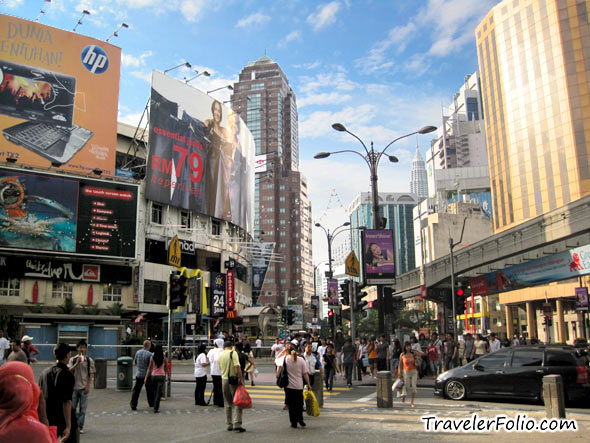
The throng of multicultural people swarm the capital city, Kuala Lumpur, affectionately referred to as KL. The city buzzes with life every hour of the day, from dawn to dusk.

Feel the excited chatter around you as you pause in front of Berjaya Times Square (one of the many malls in the heart of KL) to take a picture. The warm afternoon sun is beating on your back, and you can feel beads of sweat forming at the crown of your head.

The weather is humid in Malaysia, because this is a country without four seasons. The only season you get is one of rain and sunshine.

Look around you at the various faces; you'll see the three main flavors of Malaysia (Malay, Chinese and Indian) and some foreigners, their white faces pink from the heat. You have to walk fast, before you are engulfed by the surging stream of people.


What's that smell? Oh, that's the aroma of Indian curry from the restaurant down the street, mixed with the smell of exhaust from the speeding motorcycles. You cringe at the slow-crawling traffic, which seems to stretch from one end of the city to the other. Every minute feels like an hour to the drivers.


Drivers are blaring their honks impatiently at the other vehicles around them. Observe their annoyed expressions. Sometimes, you may catch a driver muttering under his breath. The motorcyclists nonchalantly ride their bikes swiftly through the traffic, and at that moment, every driver in his car is wishing he owned a motorcycle. You make a remark about how awful the traffic is, and a nearby Malaysian nods in agreement. "This happens every single day in KL," she tells you.

Your stomach rumbles. You've spent the whole afternoon shopping, so it's definitely time to take a lunch break. As you walk, you notice the array of restaurants on each side of the street. You can find all the flavors of the world here!

Nasi Lemak

As you settle for a plate of Nasi Lemak (a typical Malaysian dish of coconut steamed rice served with a scoop of spicy sauce known as "sambal", fried anchovies, peanuts and complemented with cucumber slices and a hard boiled egg), you find yourself wondering about this unique city which never sleeps.

At night, the city springs to life like never before. From a high vantage point, the city is a blanket of shimmering lights, pulsing with energy. The roads are flowing rivers of silver and gold as the vehicles whizz through the busy streets. The city has never looked so beautiful.


The clubs are palpitating with youngsters, dressed to the nines for a night they probably wouldn't remember after several shots of alcohol. Skinny underaged girls in skin-tight dresses giggle fervently as they totter in ridiculously high stilettos, their long, lacquered nails glinting as they fish around in their shiny purses for their fake IDs to enter the clubs.

The bouncers glance at their faces and assume they must be over 21. Thick fake lashes frame their black-rimmed eyes, and their colored contact lenses embellish their beauty. They're nowhere near 21; most of these girls are barely out of high school!

Nothing is ever like KL, a magical city throbbing with life from daybreak to nightfall. As you wander down the streets at night, notice how the street lamps bathe the pavements in an orange glow, and how the moon hangs in the velvety sky above. You can't see all the stars because they are blocked by the skyscrapers that are scattered throughout the city.


Stop walking and look around you. You'll notice how KL is a lot more charming at night. When you open your heart to the city, you'll see its true colors and feel its heartbeat.

*I don't own any rights to all the pictures posted here

Monday, September 19, 2011

Editorial: 9/11 Photographers

Here's the 9/11 editorial I wrote for class last week :) I also added some pictures to illustrate my points.

Your opinions are appreciated!


As the World Trade Center collapsed, people fled as far as they could, oblivious that a small group of photographers were racing toward the dangerous scene with cameras dangling from the straps the way their lives dangled from a thin rope of fate.

Thanks to their bravery, the 9/11 tragedy spread from New York to other parts of the world in a series of pictures and videos. Those who weren’t in New York were still able to watch the horror unfold on their screens. The photographers had captured hell on earth and locked it into frozen evidence that would change American history forever.

Photographers are the eyes of the public; they aim to enlighten the public with the truth. However, not everyone realizes the big role the photographers played that day. These heroes were the ones who brought the darkness of the day to light. They voluntarily sacrificed their safety for the public. David Handschuh, a photographer from the Daily News was injured when debris from the tower crashed on him, breaking his legs. 


He never released his camera which had captured the full events of the disaster, from the thick dark smoke rising from the tower as a result of the plane crash to the panic-stricken faces of New Yorkers as they scrambled for safety. 


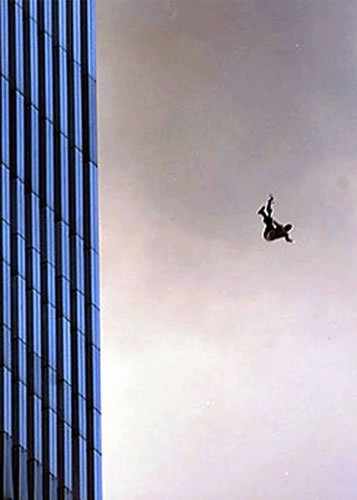
People tend to overlook the power vested in pictures. They also forget the individuals behind the photographs. Pictures are influential tools because they tend to have a stronger emotional effect on people; therefore pictures do speak louder than words. The infamous picture of the “Falling Man” taken by Richard Drew aroused discomfort and shock.

 It was a photograph of a man who had jumped from the North Tower of the World Trade Center after the plane crashed into it. He was tumbling through the air, just seconds away from his death. That picture didn’t need an article to explain what was going on; it was obvious that the jumper had chosen a quicker death against a slow, agonizing one in which he’d have to be burned alive. It’s sad to think that the last decision of his life was deciding how to die. The horror and desperation of the situation seeped into the hearts and minds of the viewers. The photograph had served its purpose.

Pictures of the 9/11 disaster reflected the true horror, shock and grief of the moment. There were snapshots of people crying on the streets, gripping photographs of their loved ones whom they’d lost in the attack. There were pictures of firefighters and police covered in debris as they emerged somberly from the rubble with dead bodies. These pictures were standalone evidence that a tragedy had struck; the photographers did a good job relating the truth of the moment to the public even after the moment had passed.

There were masses of videos on YouTube created as a tribute to the 9/11 attack which influenced the rest of the world. In the video entitled “I Believe”, a commentator in the background said that his brother was the captain of the American Airlines Flight 11 that was hijacked. “I keep looking at the cornfield behind me, hoping that my brother comes walking right out,” he said, his voice breaking. 9/11 never really died, it still lives in the hearts of many.

The photographers who risked their safety for the action should be remembered for their courage. They weren’t thinking about themselves as they ran out of their safe zones; they were thinking about the public. A decade from then, people still remember the horror of that day even though most of them weren’t there to witness it for ourselves. The pictures are proof that the tragedy really occurred, and the public just needs to remember the people responsible for the photographs.

This editorial is a tribute to the photographers of 9/11 who voluntarily sacrificed their safety for the public. These heroes deserve some credit too. When you see a photograph of the 9/11 tragedy, think of the photographer who braved his or her way to freeze it into an everlasting memory and be grateful that there are photographers out there who would go to great extremes for the public. That is the best way you can honor his or her effort. Thanks to the 9/11 photographers, the harshness of the disaster has melted into history that will always be remembered.